· Web Architecture · 8 min read
Next.js 16 vs. Astro 5.16 vs. SvelteKit 2026: AI-Native Frameworks
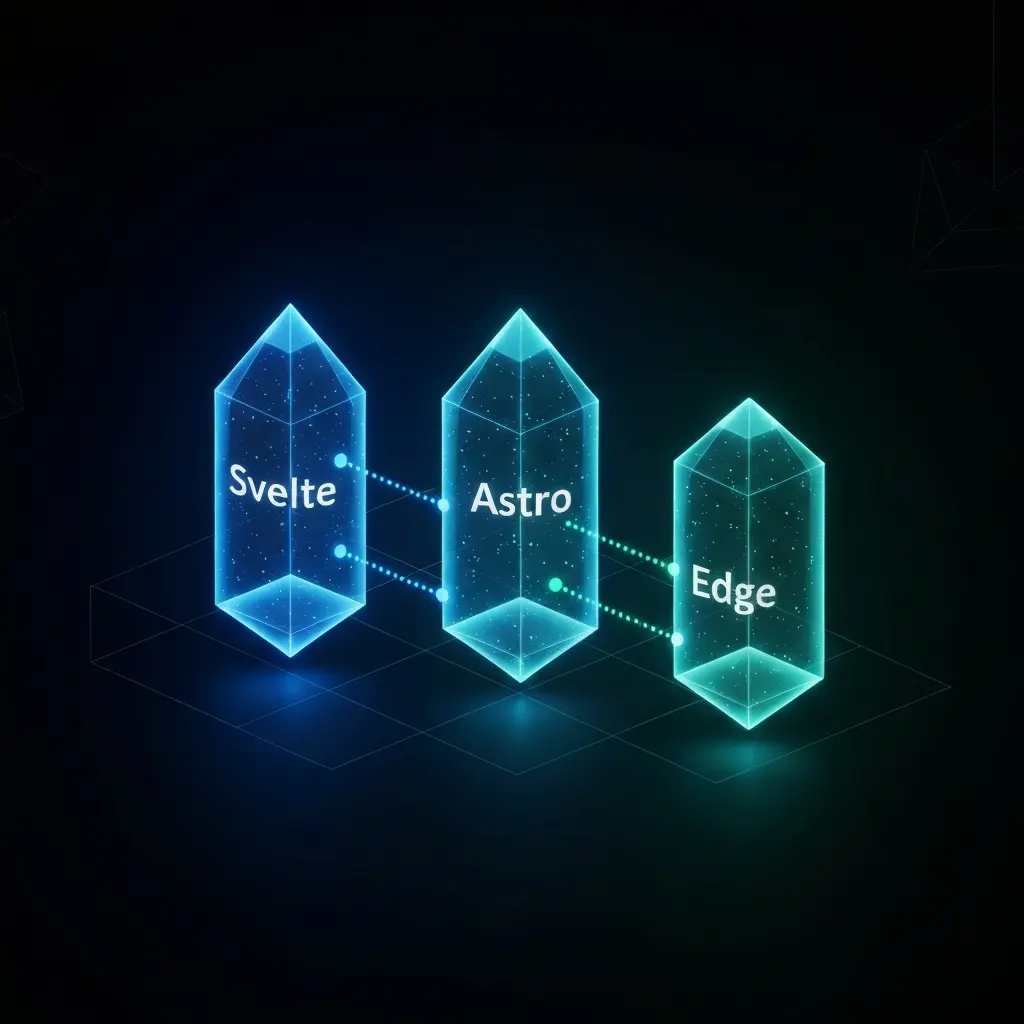
2026 has begun with a major architectural convergence: Next.js, Astro, and SvelteKit now share AI-first features and unified serverless runtimes, fundamentally changing web development.

TL;DR: The first week of 2026 marks a pivotal shift: Next.js 16, Astro 5.16, and SvelteKit have standardised Model Context Protocol (MCP) support and unified their architectural approaches around AI-native, serverless-first development, moving beyond static SSG vs. SSR debates.
The start of 2026 signals a decisive move away from the fragmented meta-framework landscape of previous years. Historically, development teams chose between Next.js’s full-stack capabilities, Astro’s static-first philosophy, or SvelteKit’s reactive compiler approach. These distinctions are now rapidly dissolving as each major project converges on a shared set of architectural imperatives: serverless edge runtime support, advanced AI tooling integration, and hybrid rendering models. This evolution is less about picking a winner and more about recognising a new standardisation layer. Next.js 16 leads this charge by formally deprecating Node.js 18, mandating modern V8 features as a baseline, and fully embracing asynchronous, AI-aware APIs. The competitive edge now lies not in rendering syntax but in how effectively a framework orchestrates resources across static, dynamic, and AI-generated content pathways. The era of AI-native meta-frameworks has arrived, fundamentally reshaping our conception of the web application stack.
What is an AI-Native Meta-Framework?
An AI-native meta-framework is a web development architecture designed from the ground up to integrate with AI agents and Large Language Models (LLMs) through standardised protocols like Model Context Protocol (MCP). It provides built-in tooling that allows AI to understand project context, perform automated migrations, and generate production-ready code. Critically, these frameworks are evolving beyond simple AI code generation to offer runtime-level features—such as intelligent caching and dynamic rendering—that are explicitly optimised for AI-driven content and interactions, moving AI from a peripheral tool to a core architectural concern.
The Engine Room: Node.js 20, Async APIs & Cache Components
The foundational shift for 2026 is the mandatory move to Node.js 20.9 LTS, as exemplified by Next.js 16 dropping support for older versions. This is not merely a version bump; it’s a prerequisite for accessing the modern V8 engine features that power advanced capabilities like the new Cache Components. This programming model unifies Partial Prerendering (PPR) and the use cache React directive into a single, stable API. The result is deterministic, instant navigation where static shell generation and dynamic data streaming are managed under a single abstraction layer.
Accompanying this is the final deprecation of synchronous access to cookies(), headers(), and params(). These core APIs are now strictly asynchronous, aligning with React 19.2’s architectural shift towards deeper Suspense integration. This enforces better data-fetching patterns at the framework level, preventing blocking operations that degrade performance, particularly on serverless runtimes. Layout Deduplication in Next.js 16 further exemplifies this performance focus, eliminating the redundant downloading of shared layout code across a user session.
// Next.js 16 Cache Component Example
import { unstable_cache as cache } from 'next/cache';

export default async function ProductList({ category }) {
  // Data fetching is now implicitly cached by the component boundary
  const products = await fetchProducts(category);

  return (
    <ul>
      {products.map((product) => (
        <li key={product.id}>
          <Link href={`/products/${product.slug}`}>
            {product.name}
          </Link>
        </li>
      ))}
    </ul>
  );
}
Pro Tip: The move to async-only
cookies()andheaders()will be a breaking change for many projects. Start migrating by wrapping existing synchronous calls inPromise.resolve()and refactoring component trees to handle Suspense boundaries gracefully.
Why Does the Model Context Protocol Matter for Developers?
The Model Context Protocol (MCP) has emerged as the critical connective tissue between AI development tools and the project runtime. Both Next.js and Svelte have released official MCP servers (next-devtools-mcp, svelte-mcp), with Astro support imminent. This transforms the AI workflow from generic code suggestion to context-aware, project-specific operations. An AI agent with MCP access can, for instance, analyse your actual next.config.js, understand your deployed routes via the development server, and then write a migration script that correctly moves data-fetching logic from Pages Router to App Router, accounting for your specific middleware and environment variables.
This standardisation means senior engineers can delegate entire classes of maintenance tasks—dependency upgrades, performance audits, CSP policy generation—to AI agents with confidence. The AI is no longer operating on a static snapshot but has real-time, programmatic access to the framework’s state and configuration. This directly impacts business velocity by reducing the cognitive load on development teams for routine upgrades and compliance tasks, freeing them for higher-value architectural work. For example, the new csp option in Svelte 5.46’s hydratable renderer, which hashes inline scripts for strict CSPs, is precisely the type of complex, tedious implementation that an MCP-enabled agent can now automate reliably.
The Rise of Unified Hybrid Rendering: Astro’s Server Islands & SVGO
While Next.js focuses on deep React integration, Astro 5.16 demonstrates the power of a framework-agnostic approach to hybrid rendering. Its now-standardised ‘Server Islands’ architecture allows developers to mix and match component technologies, recently adding full support for async Svelte rendering. This means you can have a primarily static marketing page built with Astro components, with a complex, interactive Svelte chart rendered as a dynamic island, all within the same request lifecycle. This composability is a significant advantage in micro-frontend or legacy integration scenarios.
Astro’s experimental SVGO (Scalable Vector Graphics Optimiser) integration further underscores the framework’s build-time optimisation focus. By automatically applying lossless SVG compression during the build process, it can reduce bundle sizes for image-heavy sites by an average of 15%. When combined with the new ‘Content Layer’ announced in the Astro v6.0 Alpha—which supports remote loaders for headless CMS data—the framework is positioning itself as the optimal choice for content-centric, performance-sensitive applications where developer experience and final output efficiency are paramount.
Pro Tip: For enterprise projects using headless CMS, the Astro v6.0 Alpha Content Layer with remote loaders can eliminate the need to store markdown locally. This simplifies CI/CD pipelines and reduces repository bloat, as content fetching becomes a declared, versioned build step rather than a manual sync process.
Developer Experience at the Edge: SvelteKit’s CLI & CSP Shift
Svelte 5.46.0 and the SvelteKit ecosystem are making targeted advances in developer experience and security. The Svelte CLI (sv) version 0.11.0 now automates the full setup for Cloudflare Workers and Pages, including direct binding for KV namespaces and D1 databases via a single command. This dramatically reduces the configuration overhead for deploying to edge runtimes, a critical factor as more logic moves away from traditional Node.js servers.
The introduction of the csp option within the hydratable renderer is a quieter but equally important change. It allows Svelte to hash inline hydration scripts, enabling developers to implement strict Content-Security-Policy headers without compromising the framework’s client-side hydration model. This closes a longstanding security vs. developer experience gap and reflects a mature framework addressing real-world production requirements.
// Example: Using the new SvelteKit Cloudflare CLI
# Previous multi-step manual setup replaced by:
sv deploy --platform cloudflare --bind-kv MY_NAMESPACE --bind-d1 MY_DB
The 2026 Outlook: A Convergence on AI-Native Architectures
The trajectory for the rest of 2026 is clear: the line between these meta-frameworks will continue to blur as they adopt each other’s best ideas. We predict the emergence of a de-facto standard ‘AI Tooling Layer’ built on MCP, where framework-specific MCP servers become as essential as package managers. Runtime environments will fully standardise on the low-latency edge, with Node.js 20 as the unified foundation enabling advanced compiler optimisations. The architectural debate will shift from ‘SSG vs. SSR’ to ‘orchestration and intelligence’ – how well a framework can manage a hybrid mesh of pre-rendered HTML, dynamic server components, AI-generated content, and edge functions. Expect the ‘islands architecture’ pattern, popularised by Astro, to become a common feature across all major frameworks as they seek to deliver both performance and interactivity without compromise.
Key Takeaways
- Node.js 20 is now non-negotiable. Next.js 16’s deprecation of Node.js 18 signals that modern V8 features are required for 2026’s AI and caching advancements.
- Cache Components in Next.js 16 unify rendering strategies, making Partial Prerendering a stable, default pattern for achieving instant page loads.
- The Model Context Protocol (MCP) transforms AI from a code autocomplete into a project-aware assistant capable of automated migrations and debugging.
- Astro’s Server Islands enable true multi-framework hybrid rendering, letting teams leverage the best tool for each part of the UI without performance penalties.
- Security and deployment are being streamlined. SvelteKit’s CSP support and one-command Cloudflare deployment exemplify frameworks maturing to meet enterprise production needs.
Conclusion
The simultaneous releases of Next.js 16, Astro 5.16, and Svelte 5.46 in early 2026 represent less of a competitive battle and more of a collective industry pivot. The shared themes—AI integration via MCP, serverless edge readiness, and sophisticated hybrid rendering models—signal the arrival of a new generation of meta-frameworks. For technical leaders, the focus must shift from choosing a framework based on yesterday’s criteria to evaluating how each orchestrates this new, AI-native stack. At Criztec, we are guiding our clients through this transition, helping them architect systems that leverage these convergent capabilities for sustainable competitive advantage, ensuring their platforms are built not just for today’s web, but for the intelligent, dynamic web of 2026 and beyond.